
Reaction-aware covalent docking & scoring
BCover ranks covalent ligands by asking the question that matters in covalent drug design: does the compound fit the pocket and adopt a chemically meaningful pre-reactive pose that supports the intended mechanism?
A two-step pipeline pairs constrained pre-reactive docking with quantum-chemistry-informed scoring — our original Fukui-function-based scoring model, LM5 entropy, QM transition-state geometry — so rankings carry mechanistic context, not just shape complementarity.
Average across the COValid benchmark (57% max) — above every classical docking method and AF3-Rosetta.
Average across nine targets and ten reactive sites (0.96 max) — strong binder/decoy discrimination.
Average enrichment in the top 1% of the ranked library (33 max) — where triage decisions get made.
Per ligand on AWS GPU — roughly 25× faster than the evaluated AlphaFold3 workflows.
Retrospective validation on the COValid benchmark
BCover was evaluated retrospectively on the COValid benchmark — nine targets and ten reactive sites — against AutoDock, DOCK6, DOCKovalent, AlphaFold3 with Rosetta rescoring (AF3-Rosetta) and AlphaFold3 confidence-based ranking (AF3-mPAE). BCover reached an average adjusted LogAUC of 31% (57% max), an average ROC-AUC of 0.88 (0.96 max) and an average EF1 of 18 (33 max), exceeding every classical docking method and AF3-Rosetta. AF3-mPAE delivered the strongest raw enrichment, but at roughly 25× the compute cost — at ~10 s per ligand BCover achieves the highest time-adjusted virtual-screening productivity of all methods tested.
- Adjusted LogAUC
- Early-recognition quality — how well true binders concentrate at the very top of the ranked list.
- EF1
- Enrichment factor in the top 1% of the library — the regime where triage decisions are made.
- VSPI
- Virtual-screening productivity index: enrichment per unit of compute time (% s⁻¹ᐟ²).
Early-recognition performance averaged over all ten reactive sites.
BCover (31%) outperforms AutoDock, DOCK6, DOCKovalent and AF3-Rosetta. AF3-mPAE ranks highest in absolute terms, but requires a full AlphaFold3 workflow per ligand.
Enrichment delivered per unit of compute time.
Once runtime is accounted for, BCover leads every method — including both AlphaFold3 workflows — at roughly 10 s per ligand versus ~250 s for the AF3 pipelines.
Per-target breakdown across the nine COValid targets and ten reactive sites.
BCover is the most consistent of the physics-based methods: it never collapses to zero enrichment, and it is the strongest non-AlphaFold3 method on KRAS, JAK3, EGFR, FGFR4-477 and BTK. Classical docking scores swing widely between targets — AutoDock and DOCK6 fall to zero or below on several sites.
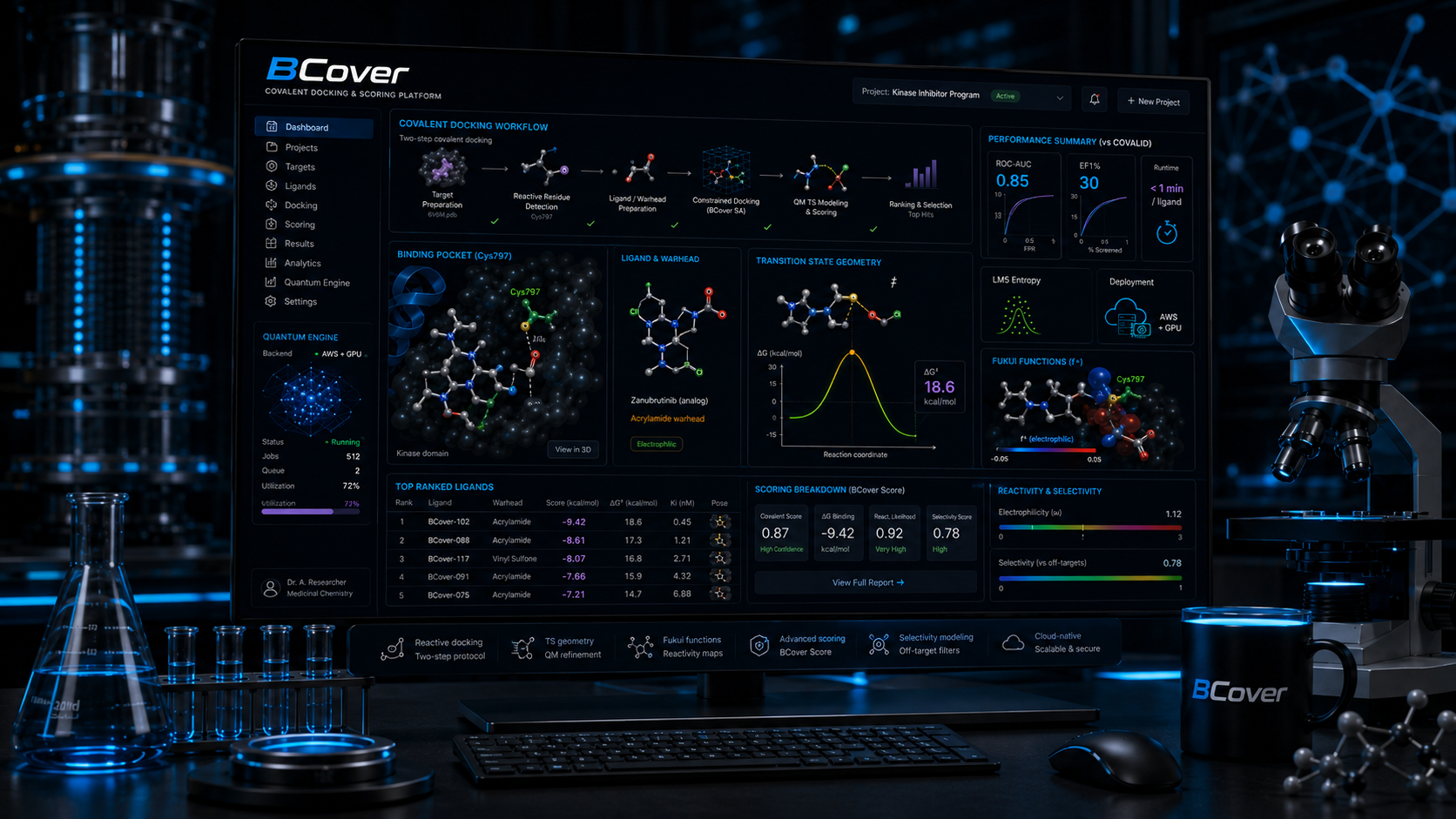
Pre-reactive docking, quantum chemistry transition-states, reactivity-aware ranking -- packaged for quality covalent inhibitors screening.
Two-step covalent docking
Pre-reactive constrained docking followed by reaction-aware scoring — separating where the ligand sits from whether it can actually react.
Reactive residue & warhead detection
Automated identification of nucleophilic residues in the pocket and electrophilic warheads in the ligand, with no manual annotation required.
Constrained pre-reactive poses
BDocker simulated annealing with a modified MMFF94 force field imposes physically motivated residue–warhead orientation constraints.
QM transition-state geometry
Reaction geometry informed by high-quality quantum-chemistry transition-state data for major covalent-binding reaction classes.
Fukui + LM5 entropy scoring
Scoring blends XTB/DFT-supported quantum chemistry, Fukui-function reactivity terms, QM-derived molecular potentials and LM5 entropy.
Cloud-native GPU deployment
Deployable on AWS with GPU support for scalable screening — fully automated from pocket detection through ranked candidate list.
How a BCover screening run reaches its ranked list.
- 01Pocket detection around the target site
- 02Reactive residue detection in the pocket
- 03Automated simulation box setup
- 04Ligand warhead detection
- 05Constrained pre-reactive docking (BDocker SA + modified MMFF94)
- 06Pocket interaction profiling of the pre-reactive state
- 07Pose scoring & ligand ranking with QM + LM5 entropy